The realities of being a competitive RC pylon racing pilot
By Tim Lampe
Sometimes you can win an individual heat race by being careful. But you’re not going to win an entire event with this approach. At some point during the competition, you are going to go against the best. When this happens, all four pilots will be going for the win, never giving any ground for an entire ten laps. And when this happens, the likelihood of crashes from “bad air” or a mid-air (collision) is highest.
As expected, competition was fierce yesterday for day 1-of-2 of Q40 class and we had the usual amount of carnage from the best pilots in the country fighting it out. In between heats, I found myself out on the course again waiting for my race. I was a first-hand, close-up witness to two crashes caused by bad air. You see, there is a premium altitude around the course where pilots have the best view of their planes and the three poles which around which we fly.
This contended space happens to be in an imaginary “lane” around the course from about 15 feet above the ground to about 40 feet above the ground. In this general, cramped area of about 25 feet, you can get the best view of your plane’s attitude to make the quickest, most miniscule corrections to aggressively attack the course. Sometimes, flying high isn’t a bad option, but the most aggressive pilots usually fly in this realm. When you get four of the best pilots in this space all at the same time, something’s gotta give!
This is when mid-air collisions are more likely or planes veer off course or into the ground in the blink of an eye because of disturbed air caused by an airplane in proximity – the dreaded “bad air.” The concept of bad air is the same reason airliners have two-minute separation between landings at the airport. But in RC pylon racing, there are no rules for separation – other than lane assignments for the moment of takeoff.
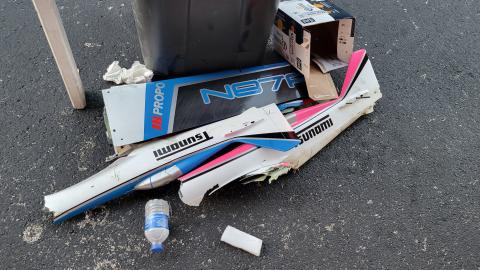
In the third round of the day, it was Richard Oliver, Travis Flynn, Lonnie Finch, and Dan Kane. You know this is going to be some close racing. But for Dan, it was over in an instant. All four planes were crowded together fighting for that prime air space, but another pilot caught bad air pushing that plane down into Dan’s, causing him to get that bad air pushing his plane into the ground. This happened in a split second and Dan’s race was over.
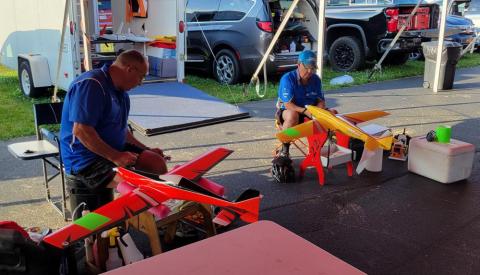
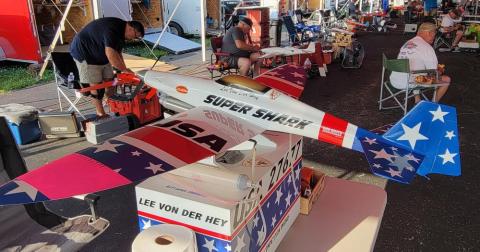
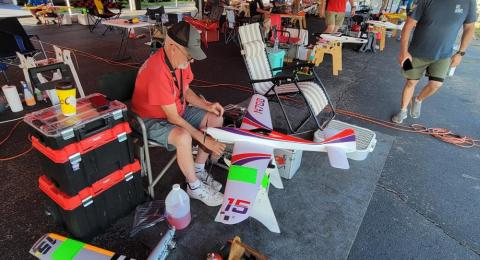
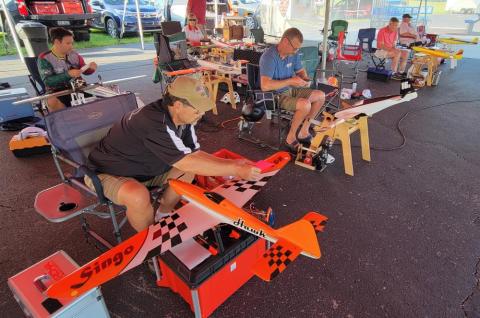
One of the peculiarities of pylon racing is, although it is the closest-knit community I’ve ever been involved with, is that no one cares, or at least notices your pain when you lose a model. The reason why is because, pylon racing demands so much of your focus and can be so hectic in the pits that everyone is working on their own program. All you can do when you lose a model is get out your backup and get back to work.
Three-Pole RC Pylon Racing – especially Quarter 40 – isn’t a cheap hobby. When we buy and assemble a plane, we already know it has an expiration date, we just don’t know when. It’s the price of entry. Losing an expensive model – practically a work of art, still hurts. But one of the main points I would like to convey here is, that it takes immense skill, fortitude and nerve to thread a carbon fiber, 60-inch model airplane with a 7-1/2-inch carbon fiber propeller turning nearly 29,000 rpm, flying 200 miles-per-hour around a 600-foot course nearly wingtip to wingtip with two or three other models simultaneously. And anyone who can do this, and especially at a high level, haa all of my respect.
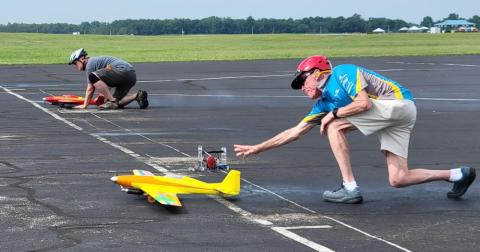
The premier class of AMA 3-pole RC Pylon Racing, Quarter 40, has commenced and day 1 of 2 is in the record books.
Watch for this year’s final issue of Nats News for RC Pylon Racing with coverage of the last day of Quarter 40 to see who comes out on top.
Link to Wednesday’s results after six rounds:
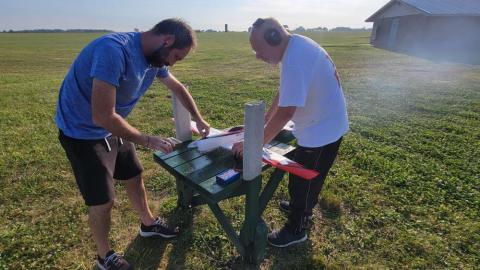
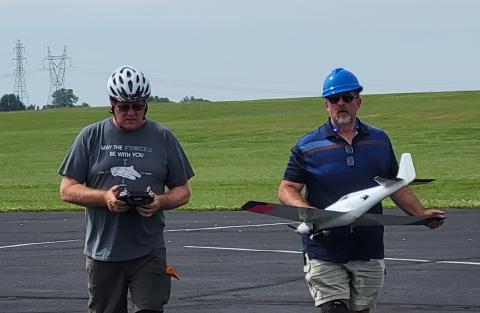 After a heat, Bill Hauth checks the settings on his transmitter as teammate Tim Gould walks Bill’s plane off the runway.
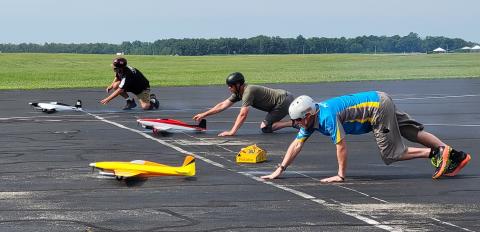 Travis Flynn pushing hard and on time to get a great launch!
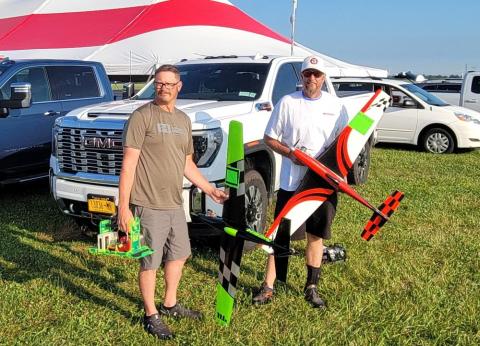
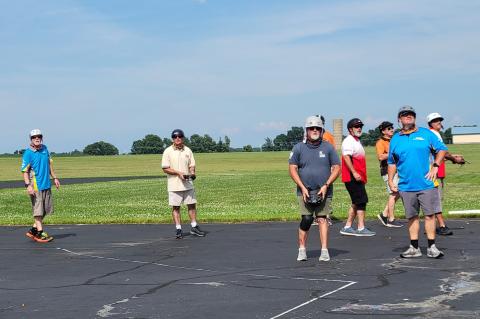 There are two pilots for each plane: the pilot and his teammate/caller. In 4-plane heats it can get quite hectic during the intensity of a race.
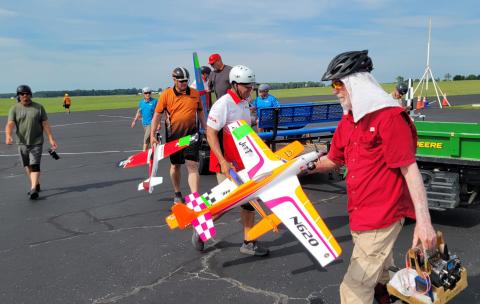 Another hectic moment, though only brief, is the embarking and disembarking from the “cart” when the next group of pilots unload to begin their race and the previous group get back on for a tow back to the pits.
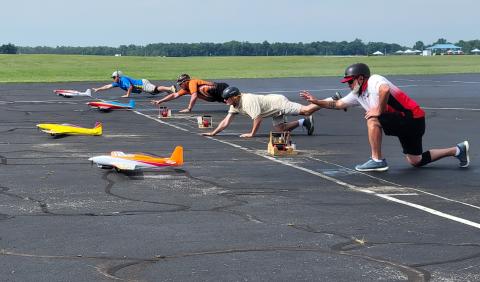 Jason Oliver gives a well-timed push to his father Rich Oliver’s Quarter 40.