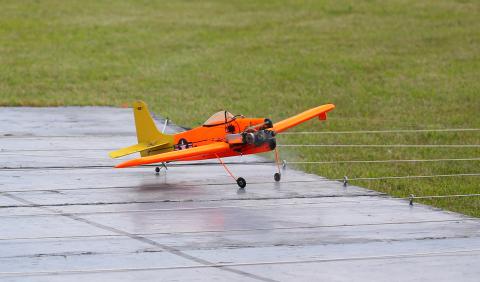
A profile Bearcat makes a landing during the 2025 Nats.
Monday, July 6 is the official start of the Control Line Navy Carrier events. The Navy Carrier events came about when the Nationals were sponsored by the US Navy and people wanted a Navy-themed event. The Navy Carrier events consist of three parts, take off and high speed, low speed, and landing. The planes take off from a simulated carrier ship and fly 1/2 mile as fast as they can. Then, they slow the plane down, signal the judges, and fly 1/2 mile as slow as they can, before signaling the judges again and making an arrested landing back on the simulated carrier ship. In every class of Carrier, the contestant receives three attempts to make two official flights. A flight becomes official when the contestant signals the judges as the model crosses the stern of the deck for the start of slow speed.
There are two categories of the carrier events, those models that are powered by internal combustion engines and those that are powered by electric motors. Each category is divided into three classes of events. The first is Profile Carrier. As the name implies, these models use a profile fuselage. Class I Carrier is the first of the two Scale Classes of Carrier. Both Class I and Class II Carrier require the use of models with built-up fuselages. With the internal-combustion-powered planes, the size of the motor determines which class they are in. While in the electric-motor-powered scale classes of carrier, the weight of the model with the battery determines what class they compete in.
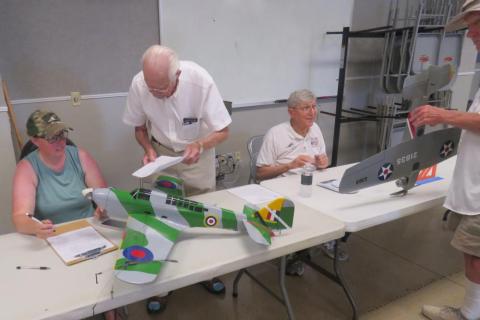
While the actual start of competition will be on Tuesday, July 7, processing will be held on Monday, July 6. Processing for the Profile classes consists of ensuring the plane has a wingspan of 50 inches or less and has a minimum wing area of 300 square inches. Planes powered by internal combustion engines can weigh up to 4 pounds, while those powered by electric motors must weigh 3.5 pounds or less (including the battery). The weight of the model is used to determine the pull test that the model must pass prior to each flight.
In both the Class I and Class II classes of Navy Carrier, the maximum wingspan is 44 inches, with no minimum wing area required. An Electric Class I plane has a maximum weight of 3.5 pounds including the weight of the battery. An internal-combustion-powered Class I model can weigh up to 4 pounds and have an engine displacement of .4028 cubic inches. A Class II Electric Carrier model must weigh more then 3.5 pounds and less than 4.5 pounds. An internal-combustion Class II Carrier model must have a motor between .4029 cubic inches and .65 cubic inches, and can weigh up to 4 pounds.
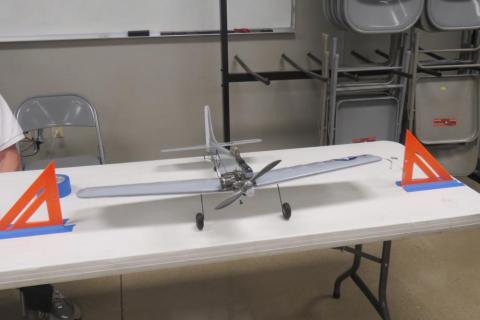
In order to receive the ten scale bonus points, the profile models only need to resemble an actual airplane that made an actual arrested landing on a carrier ship, or was intended to be capable of making an arrested landing. A non-scale model may be flown in the event, but will not receive the scale bonus points. In all four of the Scale classes of Carrier, in order to receive the 100 scale bonus points, the outline of the model must be within 5% of the actual outline of the full-scale aircraft. A profile model may be flown in the scale classes of Carrier, but will not be eligible for the scale bonus points.
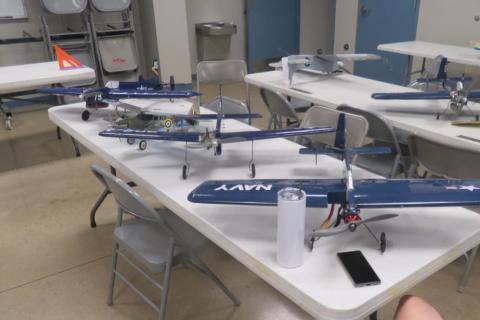
The Profile classes of carrier will be flown on Tuesday, July 7, while the Scale classes of Carrier will be flown on Wednesday, July 8. Thursday, July 9 will be the day the unofficial events of 15 Carrier, Skyray 35 Carrier, and Nostalgia Carrier will be flown.
The Carrier events will start at 9:00 a.m. on all three days, and end by 4:30 p.m.
The Carrier events will be flown on the southeast corner of site 5.